
Hey everyone! In the raw food and health movement, many of us were conditioned to stay away from calcium supplements because of fears about calcification. Calcium carbonate and other forms may theoretically do that, but Calcium L-Threonate is a completely different ball game. If I had to choose one calcium supplement on the planet, this would be it. For the first time ever, it makes me feel OK about taking a calcium supplement.
- Stopping the body from stealing calcium from bones
- Builds bone and slows breakdown at the same time
- Collagen, cartilage and fractures
- Absorption, like Magtein
- What customers say
- My own bone and teeth story
- Safety, and why not calcium orotate?
- How to take it (dosage chart)
- FAQ
- From Matt’s newsletters
- Get Calcium L-Threonate
1. Stopping the Body From Stealing Calcium From Bones
Calcium does many jobs besides feeding the bones, so when we run low, the body steals it from them. This is called bone resorption: cells called osteoclasts break down bone and release calcium into the blood. As we age, this can lead to weaker bones and joints.
A clinical study concluded that “L-threonate, especially calcium L-threonate could inhibit the bone resorption of osteoclasts.” In that study, the drugs alendronate and estradiol inhibited resorption even more – but they have side effects and contain no calcium. Calcium L-Threonate supplies highly absorbable calcium, so the body has less reason to pull it from the bones, and the L-threonate itself appears to gently influence the cell signaling involved in bone breakdown, restoring balance rather than aggressively shutting it down.
2. Builds Bone and Slows Breakdown at the Same Time
Studies connected to the Calcium L-Threonate patent show it also promotes proliferation and mineralization of osteoblasts, the cells that build bone. So it inhibits the osteoclasts while promoting the osteoblasts. In plain terms: it slows the breakdown of bone and remineralizes it at the same time. It’s the perfect combination for bone health. → See Bone Health.
3. Collagen, Cartilage and Fractures
L-threonate is one of the main metabolites of vitamin C and supports our collagen needs. Patent studies show Calcium L-Threonate increased collagen I expression in cartilage cells and osteoblasts, increased bone collagen, promoted bone and cartilage matrix and proteoglycans, and promoted bone-nourishing blood vessels and bone microcirculation – with potential for cartilage and joint support.
Another patent describes it for bone fractures: it “facilitated bone fracture healing and increased bone density and mechanical performance.” A further patent cites five studies, including “the Enhancing Effect of Calcium L-threonate on the Bone Mineral Density of Preschool Children” and its effect on babies with rickets. → See Joint Health.
4. Absorption, Like Magtein
It works the same way as Magtein (Magnesium L-Threonate), where threonic acid lets magnesium cross the blood-brain barrier. Here, the same vitamin C compound is coupled with calcium, delivering it into the bones more effectively than calcium carbonate, gluconate or acetate – absorption is said to be up to 95%. Magtein was developed for memory; Calcium L-Threonate was developed for bone health and calcium deficiency. One study found it was absorbed rapidly, and better with food.
5. What Customers Say
“This product is phenomenal. I’ve been taking it for 3 months. I had bone pains in my ribs, arms, hands, back, now it’s all gone … I simply take half teaspoon at bedtime and never miss a dose.” – Dave
“The calcium l-threonate is the only calcium supplement I have taken that does not give me leg cramps, and I have tried many forms … Taking for bone bruising and micro fractures. Thanks for making this available to us!” – Nisha
6. My Own Bone and Teeth Story
During my severe health issues my bone density became very poor, which is very uncommon in a man my age. With my colon removed, my absorption isn’t the best, and I was deficient in protein, calcium, iron and sodium. No matter how many supplements I took, my levels kept suffering – until I brought fresh carrot/spinach juice back twice a day. Within a few months my deficiencies went away, and my blood calcium was good even without calcium supplements. Dr. Norman Walker said one pint of carrot juice daily has more constructive body value than 25 pounds of calcium tablets. → See Carrot Juice Powder.
I also once noticed the bottoms of my front teeth losing their bright white color and becoming demineralized. It freaked me out. I took calcium along with our Calcium L-Threonate every day, and within less than two weeks my teeth were super white again. → See Dental Health.
7. Safety, and Why Not Calcium Orotate?
A 20-page European Food Safety Authority (EFSA) panel reviewed Calcium L-Threonate as a calcium source and found it safe with flying colors; in its studies it was absorbed better than calcium acetate and carbonate, and in one, better than gluconate. Many natural health doctors recommend calcium orotate because it also has a carrier, but the same EFSA panel concluded orotate minerals are “of safety concern,” citing several animal studies across species.
How it’s made: calcium carbonate and ascorbic acid go through hydrogen peroxide oxidation to form calcium ascorbate, which then reacts under the action of enzymes to become Calcium L-Threonate – almost like predigesting it. Ours is a single ingredient with no fillers like maltodextrin.
How to Take It
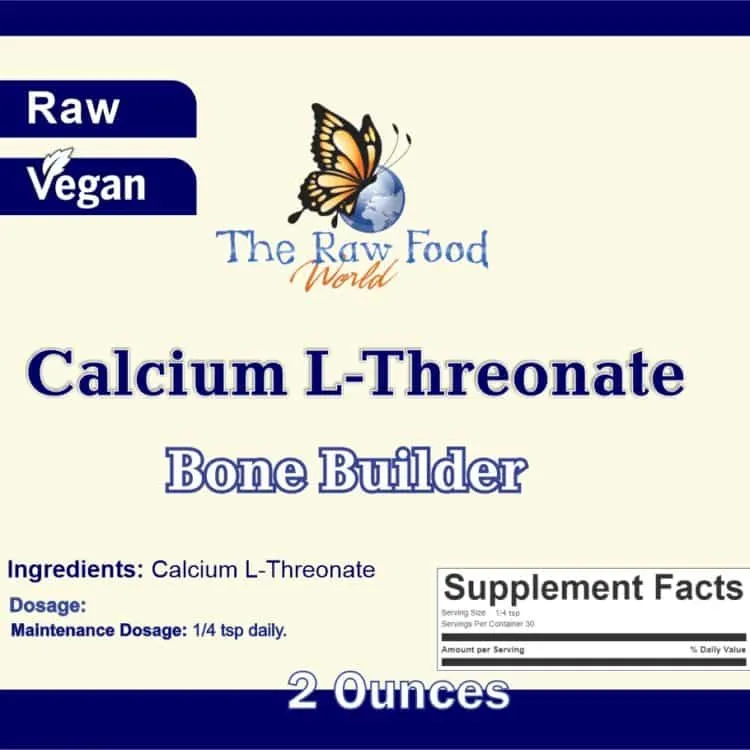
It has no taste and isn’t chalky. Stir 1/4 teaspoon into water (a shot glass is fine) and take it with food – I put mine in raw goat milk. Because it’s so well absorbed, you don’t need an excessive dose. One bag lasts 36 days at 1/4 teaspoon a day.
- 1/4 teaspoon = 1,250 mg Calcium L-Threonate = 166.5 mg elemental calcium
- 1/2 teaspoon = 2,500 mg = 333 mg elemental calcium
- 3/4 teaspoon = 3,750 mg = 499.5 mg elemental calcium
- 1 teaspoon = 5,000 mg = 666 mg elemental calcium
- 1 1/2 teaspoons = 7,500 mg = 999 mg elemental calcium
Studies suggest 1/4 teaspoon twice a day is enough for bone-signaling benefits over time. Doctors generally recommend getting part of your calcium from food. I’d always pair it with our Kale Juice Powder: 1 teaspoon gives 221 mg calcium, 71.4 mg magnesium and 1,196 µg vitamin K, the key bone co-factors.
Calcium L-Threonate FAQ
What is calcium L-threonate?
Calcium bound to L-threonate, a vitamin C metabolite that carries calcium through the intestines into the bones – the same concept as Magtein for magnesium.
How is it different from other calcium supplements?
Studies show it inhibits bone-resorbing osteoclasts while promoting bone-building osteoblasts and collagen, and it’s absorbed up to 95%.
How much should I take?
1/4 teaspoon (166.5 mg elemental calcium) a day, or twice a day for bone signaling. People with serious bone issues may take more; see the chart above.
Does it cause calcification?
Matt explains the calcification concerns relate to forms like calcium carbonate. Calcium L-threonate is directed into the bones by its L-threonate carrier.
Is calcium orotate better?
An EFSA panel found Calcium L-Threonate safe but called orotate minerals a safety concern based on several animal studies.
Is this medical advice?
No. This is educational information from Matt’s 30+ years with superfoods. Please talk with your healthcare practitioner about any health concern.
From Matt’s Newsletters
- May 25, 2026 – Calcium L-Threonate: New Information
Get Calcium L-Threonate
Calcium L-Threonate · pairs with Kale Juice Powder

These statements have not been evaluated by the Food and Drug Administration. These products are not intended to diagnose, treat, cure, or prevent any disease.